Virtual Sensors for Smart and Predictive Fleet Management

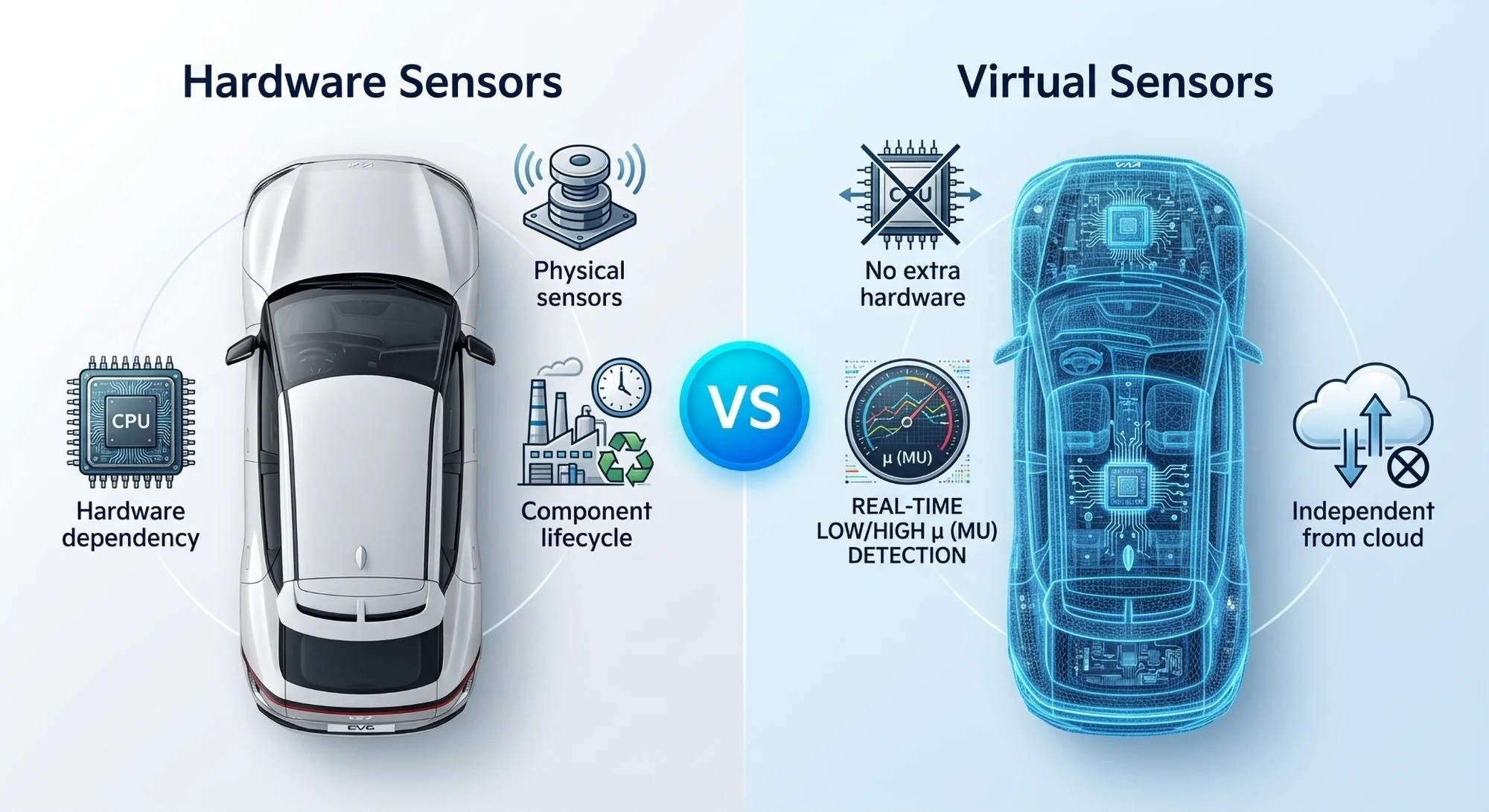
Fleet managers across Europe face a clear operational pressure: reduce unplanned vehicle downtime and comply with increasingly data-driven safety standards – without proportionally increasing hardware costs. Virtual sensors – software algorithms that derive physical measurements from data already present on the vehicle – are emerging as a practical answer to both challenges. From tire wear estimation to real-time grip detection, these systems extract measurable value from signals that vehicles already generate, requiring no additional physical components.
What Virtual Sensors Are and How They Work in Connected Fleets
A virtual sensor is a software layer that infers the state of a physical parameter – tire pressure, road friction, wheel alignment – by processing existing vehicle data streams. Rather than installing dedicated transducers, virtual sensors analyze inputs already available on the vehicle’s communication bus: wheel speed, steering angle, lateral acceleration, and brake torque, among others.
Two modelling approaches dominate the field. Physics-based models apply known mechanical and thermodynamic equations to derive states from first principles – for example, inferring tire wear from the relationship between rotational speed differential and expected deformation patterns. Data-driven models, trained on large datasets of vehicle telemetry, use statistical inference to detect anomalies and predict failure modes without explicit equations. In production deployments, hybrid approaches combine both, using physics-based constraints to keep machine learning outputs within physically plausible bounds.
For fleet applications, the practical advantage is scalability. Because virtual sensors are software-defined, they can be deployed fleet-wide via over-the-air (OTA) updates, and their sensing capabilities can be extended or refined without touching the vehicle hardware.
Predictive Maintenance and Cost Reduction
The economic case for virtual sensors in fleet management centers on the transition from scheduled to condition-based maintenance. Traditional maintenance schedules rely on mileage or time intervals, which are statistical proxies for actual component wear. Virtual sensors provide direct, continuous estimates of component health, enabling fleets to calculate the Remaining Useful Life (RUL) of tires, braking components, and wheel assemblies with considerably greater precision.
This shift has concrete financial implications. Replacing a tire based on measured tread degradation – rather than a fixed interval – reduces both premature replacements and the risk of in-service failures. Detecting wheel misalignment early, before it accelerates uneven wear across an axle, prevents the compounding cost of replacing multiple tires ahead of schedule. Virtual tire pressure monitoring (iTPMS), which identifies the specific underinflated tire by analyzing vehicle dynamics, eliminates the need for dedicated hardware pressure sensors while maintaining compliance with regulatory requirements.
For large fleets operating across diverse route profiles, aggregating this telemetry centrally allows maintenance planners to prioritize interventions by urgency and geography, reducing the operational disruption of unscheduled stops.
Safety, Local Hazard Warnings, and Euro NCAP 2026 Mandates
The regulatory landscape is formalizing what the industry has been building toward. Starting in 2026, the Euro NCAP Safe Driving Vehicle Assistance Protocol requires vehicles to both transmit and receive local hazard warnings to achieve top safety scores. Vehicles that process this data and alert drivers in real time can earn up to 1.35 points in the Safety Assist category.
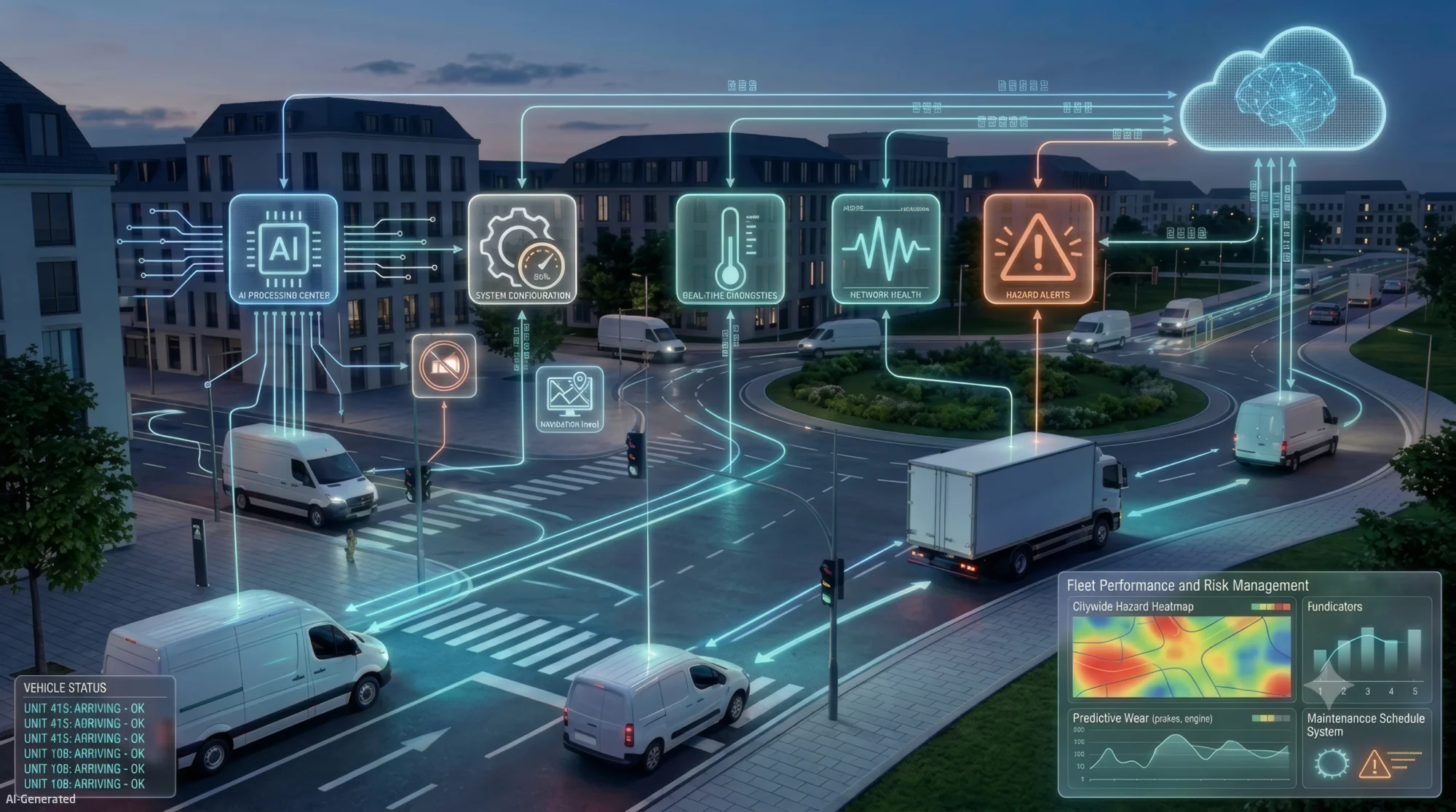
The data exchange infrastructure for this requirement is the Data for Road Safety (DFRS) ecosystem – a multi-party platform for exchanging Safety-Related Traffic Information (SRTI) involving manufacturers, service providers, suppliers, and public authorities. Under this framework, connected vehicles function as distributed mobile sensors: detecting transient conditions like slippery road surfaces or reduced visibility and contributing that intelligence to a shared, continuously updated hazard map.
Services such as HERE aggregate this vehicle-sourced data with traffic and infrastructure feeds, providing fleet operators and ADAS systems with proactive, real-time hazard awareness that extends well beyond the vehicle’s own sensor range. For fleet managers, this translates directly into route-level risk assessment and the ability to flag high-risk road segments before a vehicle encounters them.
The Easyrain Ecosystem: Virtual Sensing Meets Road Safety
Italian tech company Easyrain has built a product architecture that addresses both the vehicle-level sensing challenge and the fleet-level data aggregation requirement from a single, integrated platform.
The DAI – Virtual Sensor Platform operates entirely in software, requiring no additional hardware, tires-dependency, internet connectivity, or AI inference at runtime. It reads from the vehicle’s existing data architecture to detect aquaplaning conditions in milliseconds, identify snow and ice before tire slip occurs, estimate tire wear to 0.5mm tread depth accuracy, detect wheel misalignment, and flag loose wheel patterns before they become mechanically significant. The platform also includes road surface type detection – including rumble strips – enabling ADAS systems to adapt their calibration based on infrastructure context rather than relying solely on visual perception.
This last capability is significant for autonomous driving contexts: by giving vehicles a software-defined “haptic sense,” DAI provides environmental data that cameras, radar, and LiDAR cannot directly supply – namely, the physical quality of the tire-road contact patch.
The active counterpart is the AIS – Active Safety System, the first active system to restore grip before control is lost. Where DAI detects the risk, AIS responds physically: by spraying pressurized fluid ahead of the tires to eliminate the water layer responsible for aquaplaning. In validated performance testing, AIS delivers a 20% reduction in braking distance on heavily wet surfaces and a 225% increase in lateral traction under aquaplaning conditions, at a minimum system weight of 2.7kg in its lightest configuration. This positions AIS above the operational ceiling of ABS and ESC, which cannot intervene once the tire has lost surface contact.
The data layer connecting detection and response to the fleet operator is the ERC – Cloud Infrastructure platform. ERC aggregates real-time grip condition data, road hazard information, and vehicle health metrics across an entire fleet. For fleet managers, this means centralized visibility into road risk by route, predictive maintenance scheduling driven by actual vehicle condition, and the ability to generate live road maps highlighting low-grip zones and deteriorating surfaces. ERC’s AI integration layer further enables the platform to function as a self-learning system, improving its predictive models as operational data accumulates.
Taken together, DAI, AIS, and ERC represent a technically coherent stack: virtual sensing at the vehicle level, active physical response at the mechanical level, and fleet-wide intelligence at the cloud level.
Future Outlook: Edge-to-Cloud Integration for Software-Defined Fleets
The broader trajectory of the automotive industry points toward centralized computing architectures – replacing distributed networks of Electronic Control Units with high-performance compute platforms capable of running complex software stacks in real time. In this Software-Defined Vehicle (SDV) paradigm, virtual sensors are not an add-on; they are a native component of the vehicle’s sensing architecture, updatable and extendable throughout the vehicle’s operational life.
For fleets, the edge-to-cloud architecture becomes the operational backbone. Safety-critical functions – aquaplaning detection, grip loss warning – execute at the vehicle edge with latency measured in milliseconds. Fleet-level analytics, predictive maintenance scheduling, and hazard map generation operate in the cloud, where data from thousands of vehicles can be aggregated and analyzed continuously.
The convergence of DFRS compliance requirements, Euro NCAP 2026 scoring criteria, and the technical maturation of virtual sensor platforms suggests that condition-based, data-driven fleet management will become the standard operating model for European commercial and passenger fleets within this decade. The enabling technologies – software-defined sensing, cloud telematics, and active safety systems – are already in deployment.