Virtual Sensors vs Hardware Sensors: How Automotive Sensing Is Evolving
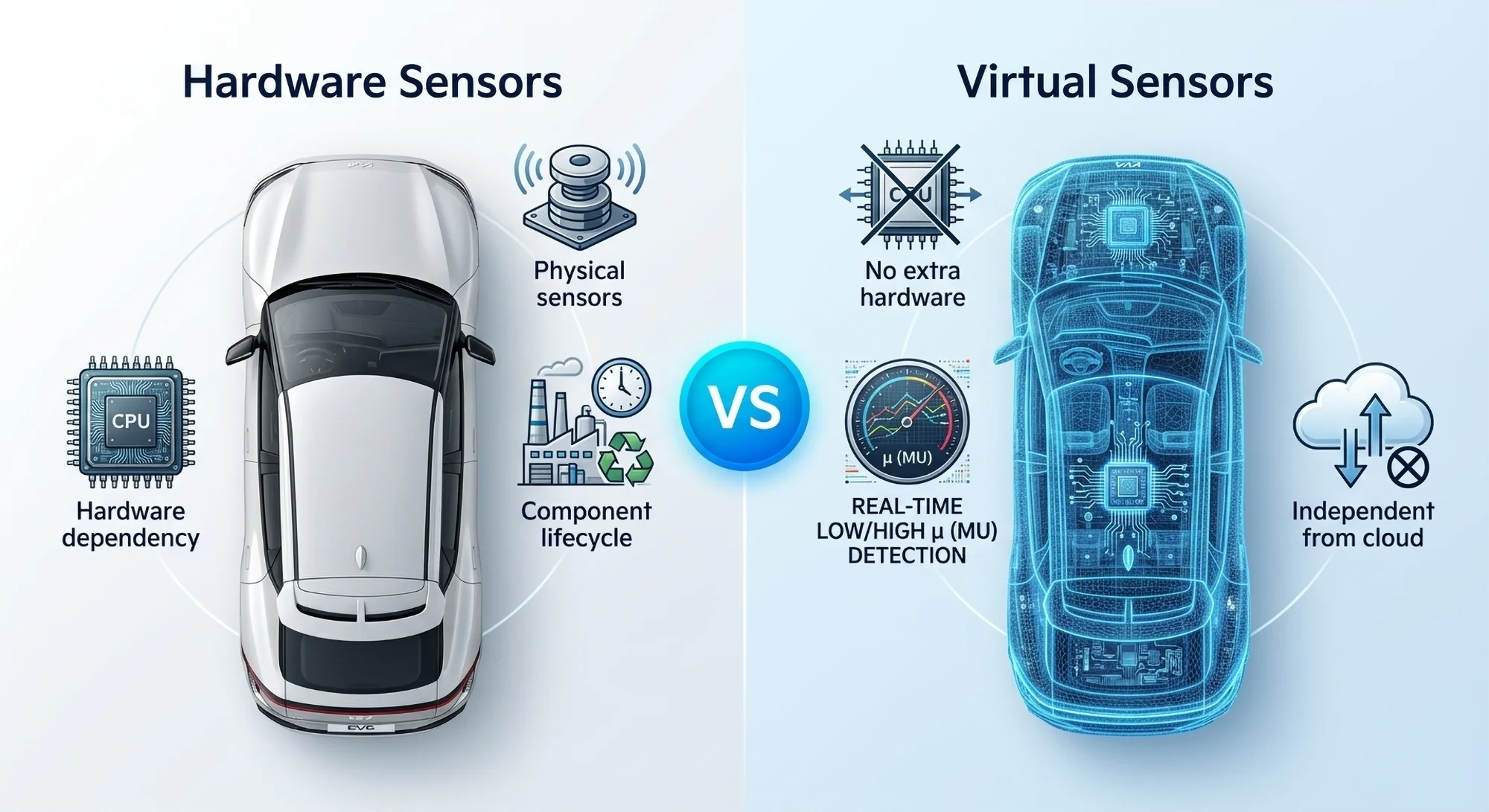
The automotive industry is undergoing a structural shift in how vehicles perceive their environment, bringing the topic of virtual sensors vs hardware sensors to the forefront. For decades, sensing relied on discrete physical hardware: pressure transducers, dedicated IMUs, dedicated tire-pressure monitors, dedicated rain sensors. Each parameter required its own physical device, its own supply chain, its own calibration routine, and its own failure mode. Consequently, Software-Defined Vehicles (SDVs) are dismantling this model by decoupling the estimation of physical quantities from the physical hardware that has historically produced them. The result is a new category of sensing function known as the virtual sensor.
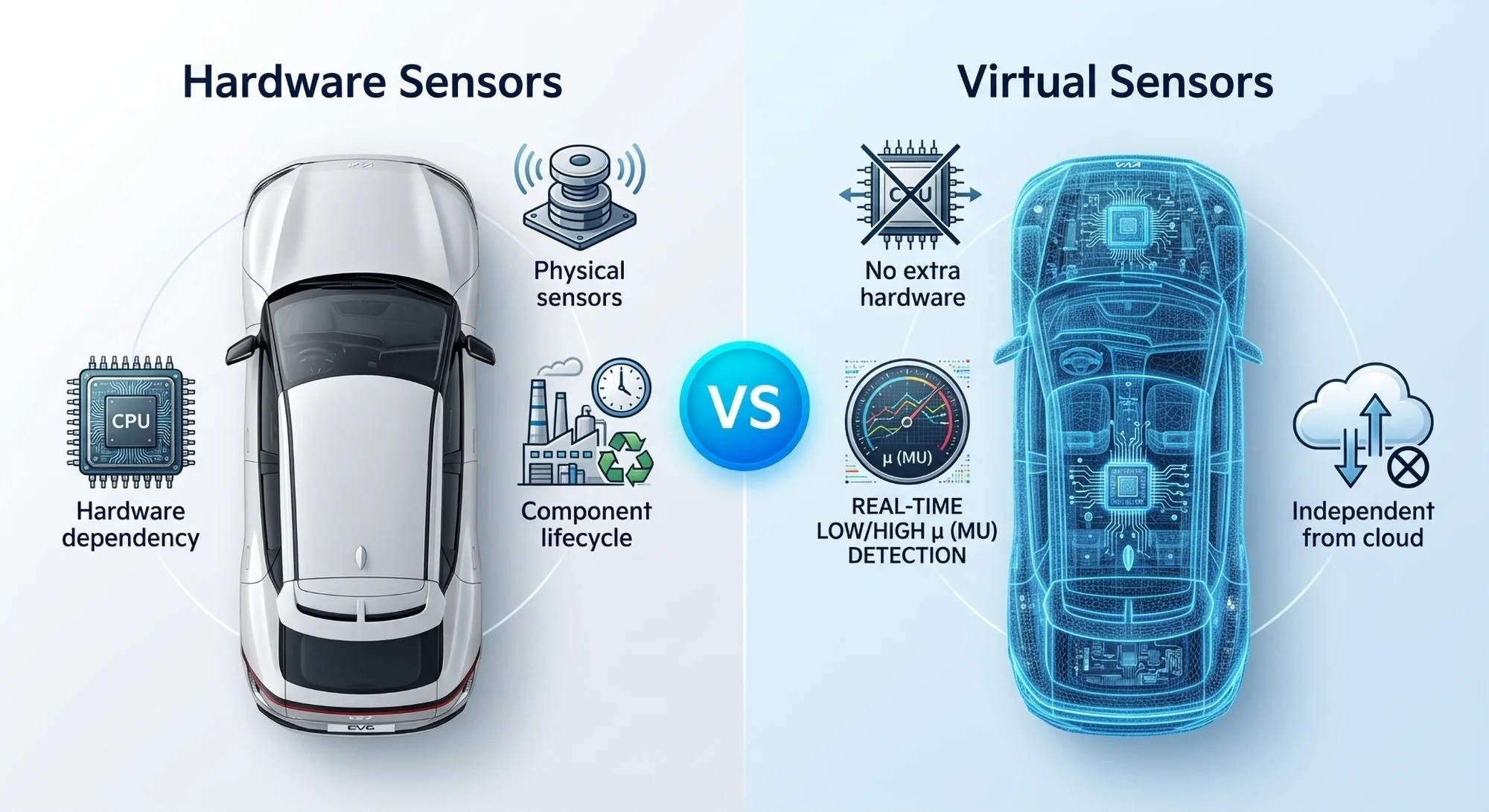
A virtual sensor is a software function that infers a physical variable – grip level, tire pressure, tread depth, wheel alignment – by processing signals already present on the vehicle’s data bus. No additional hardware is required. The intelligence is in the algorithm.
What Happened: The Architectural Shift
The SDV transition has accelerated the adoption of zonal and High-Performance Computing (HPC) architectures. Specifically, this concentrates processing power in central compute units rather than distributing it across dozens of isolated ECUs. As a result, this centralization has created the computational headroom needed to run complex estimation algorithms in real time. Indeed, this is the prerequisite for viable virtual sensing.
Between 2024 and 2026, virtual sensing moved from R&D proof-of-concept to production-grade implementation across major OEMs and Tier 1 suppliers. The core technical approach draws on sensor fusion. For instance, wheel speed signals, steering angle, yaw rate, and IMU data are combined. These signals are already present in any modern vehicle for stability control purposes. Then, they are processed through model-based estimators and, in some architectures, hybrid AI-physics algorithms. The hybrid approach is significant because pure machine-learning models introduce black-box behavior. Therefore, they are incompatible with functional safety requirements (ISO 26262 ASIL-B and above). Industry research, documented through IEEE Xplore and academic platforms such as MDPI, increasingly favors architectures that combine deterministic observers with AI layers responsible for adaptive parameter estimation. Moreover, these observers often use Iterative Extended Kalman Filters operating over single-track vehicle models.
Furthermore, standardization bodies including COVESA and the Eclipse SDV Working Group are formalizing middleware and API specifications. This ensures virtual sensor outputs remain interoperable across hardware-agnostic platforms.

Why It Matters: Case Study – Easyrain DAI
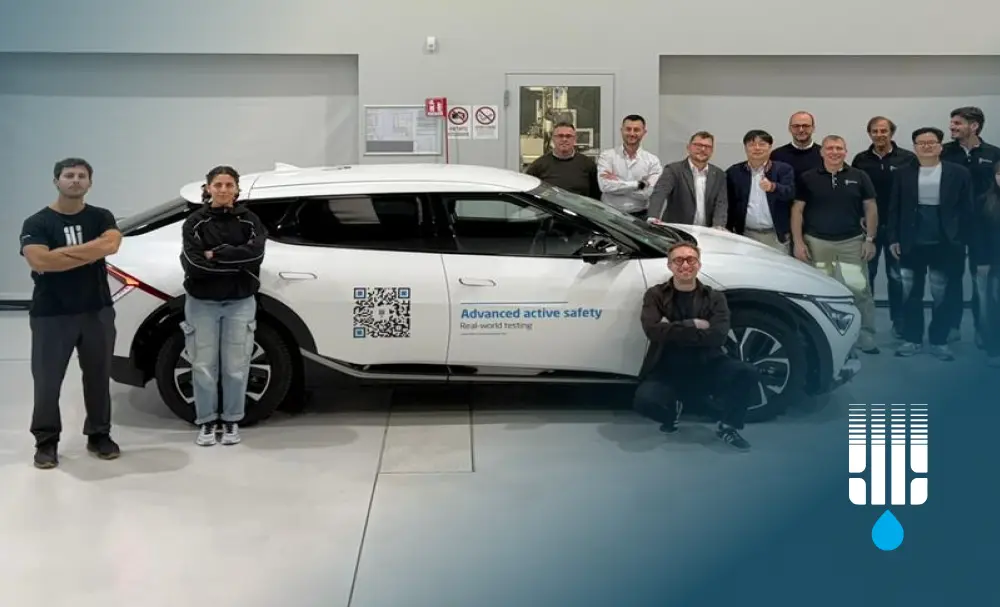
Easyrain’s DAI (Virtual Sensor Platform) is a production-oriented virtual sensor platform. Importantly, it demonstrates what the SDV sensing shift looks like in practice.
DAI processes existing vehicle telemetry – primarily wheel speed signals and IMU data available on the CAN bus. By doing so, it detects and classifies road surface conditions in real time. Its aquaplaning virtual sensor identifies partial and full aquaplaning onset in milliseconds. Furthermore, it does this without requiring dedicated rainfall sensors, optical sensors, or any new hardware installation. Additionally, it is self-calibrating and independent of tire brand or type. This removes a key constraint that has historically limited grip-estimation systems.
Extending Virtual Sensing to Vehicle Health
Beyond aquaplaning, DAI extends the same hardware-free estimation methodology across a broad portfolio of vehicle health and road surface parameters:
- Snow & Ice detection: grip reduction identified before tire slip occurs
- Irregular terrain recognition: pothole and gravel detection via road feedback analysis, independent from suspension sensors
- ITPMS (Indirect Tire Pressure Monitoring): identifies the specific underinflated tire by analyzing wheel dynamics, replacing a dedicated hardware TPMS unit
- Tire wear tracking: estimates tread depth to 0.5 mm resolution by analyzing dynamic wheel behavior
- Wheel misalignment detection: identifies asymmetries in tire-road interaction that degrade braking and increase wear
- Loose wheel sensing: detects microscopic loosening patterns before mechanical failure
- Rumble strip / Road-to-Vehicle Communication: enables predictive ADAS calibration without cameras, radar, or LiDAR
When DAI detects a critical grip threshold, it can trigger Easyrain’s AIS (Active Safety System). Specifically, this is a compact hardware module that applies pressurized fluid ahead of the tires to physically eliminate the water film causing aquaplaning. This DAI-to-AIS chain illustrates a key architectural principle of the SDV era. In essence, virtual sensors handle the detection and classification intelligence, while targeted hardware handles the physical intervention. Thus, each layer is optimized for its function, and neither layer overextends its scope.
Finally, road and grip data collected by DAI-equipped vehicles feeds into Easyrain’s ERC (Cloud Infrastructure). This enables fleet-level and city-level road intelligence, including live hazard mapping, predictive road maintenance planning, and connected safety feeds for autonomous systems.
Key Metrics: Virtual Sensors vs Hardware Sensors Attributes
| Attribute | Dedicated Hardware Sensor | Virtual Sensor (e.g., DAI) |
|---|---|---|
| Additional hardware weight | 200 g – 2+ kg per sensor | 0 g (uses existing signals) |
| Detection latency | Dependent on polling rate | Milliseconds (real-time) |
| Marginal cost per vehicle | €5 – €80 per sensor unit | Near-zero (software update) |
| Calibration requirement | Physical, per-vehicle | Self-calibrating |
| OTA updateability | None | Full (algorithm updates) |
| Tire/suspension dependency | Often sensor-specific | Independent |
| Supply chain exposure | High (dedicated components) | Minimal |
Market & Regulatory Context
Regulatory pressure is accelerating the adoption of software-defined safety functions. For example, the EU General Safety Regulation (GSR 2022/1426), fully applicable from 2024, mandates Intelligent Speed Assistance (ISA), advanced Emergency Braking, and Lane Keeping Assist across all new vehicle categories. Meanwhile, Euro NCAP’s 2025 and 2026 assessment protocols assign increasing weight to systems that provide active safety contributions in adverse road conditions. Notably, this is precisely the domain where virtual sensor-based grip estimation operates.
McKinsey & Company identifies predictive maintenance and internal data utilization as the primary near-term value drivers of vehicle software monetization. Consequently, virtual sensors are the data source enabling both. Additionally, SAE International technical papers document the integration of soft-sensor frameworks into production ADAS validation pipelines. Similarly, it confirms the industry-wide transition toward virtual sensing.
Future Outlook
As vehicles progress toward SAE Level 3 and Level 4 autonomy, virtual sensors will become load-bearing components of the safety architecture rather than supplementary features. In fact, autonomous systems require continuous, low-latency environmental awareness across conditions that visual sensors (cameras, LiDAR) cannot fully cover. These include heavy rain, dense fog, snow-covered lane markings, and submerged road surfaces. Therefore, virtual sensors operating on vehicle dynamics data are structurally better suited to these conditions. This is because they measure what is happening at the tire-road interface directly, rather than inferring it from optical data.
Ultimately, the integration of virtual sensor outputs into digital twin environments – for continuous validation and software improvement post-deployment – will further compress development cycles. Moreover, it will enable OTA feature delivery without hardware recalls.