China Establishes Unified Safety Baseline for L3/L4 Autonomous Driving

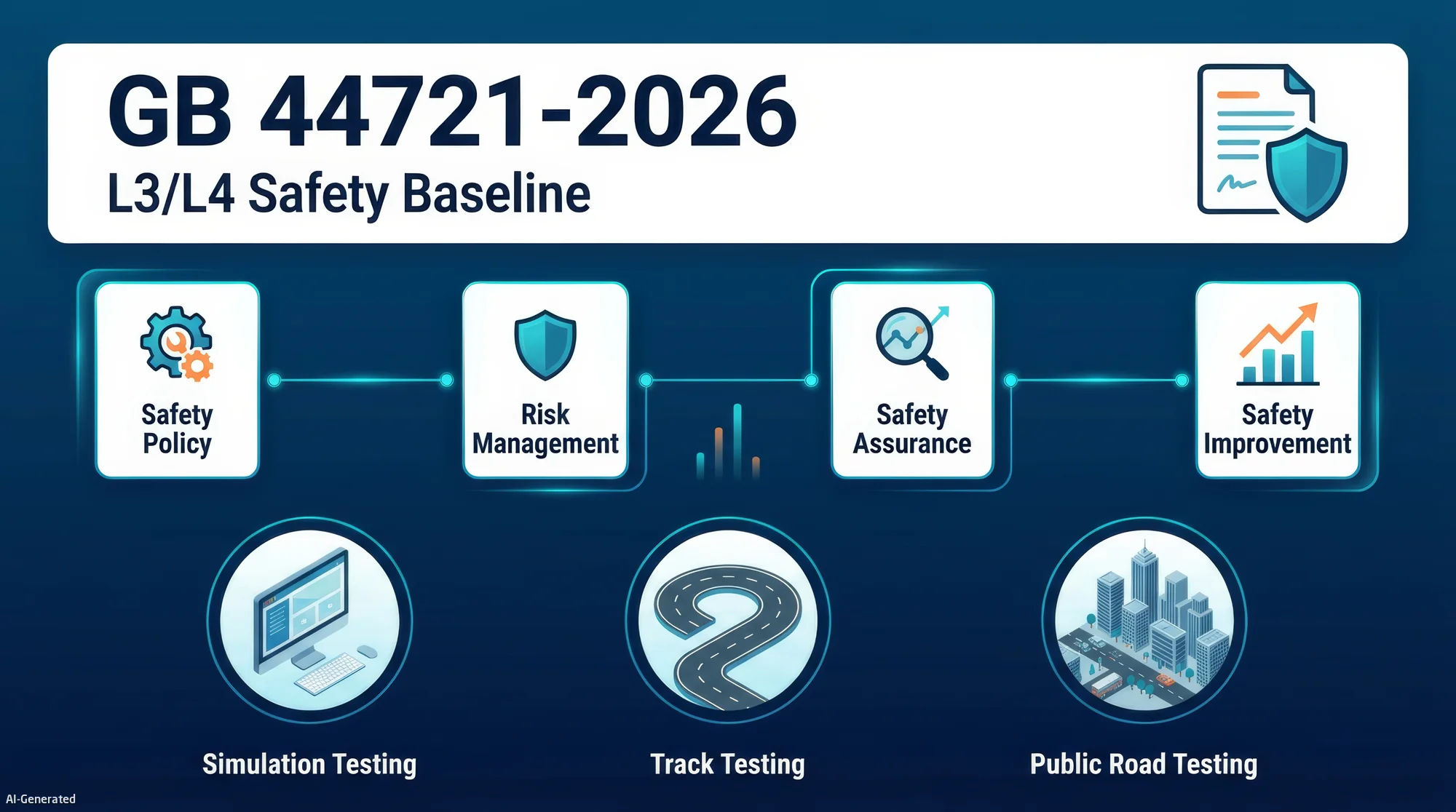
China has enacted its most consequential autonomous vehicle regulation to date. The mandatory national standard GB 44721-2026 – Safety Requirements for Automated Driving Systems of Intelligent Connected Vehicles – establishes a binding legal framework for Level 3 and Level 4 vehicles and will take effect on July 1, 2027. It arrives as the global regulatory landscape for self-driving technology is hardening fast, and its implications extend well beyond China’s borders.
What Happened
The Ministry of Industry and Information Technology (MIIT), jointly with the State Administration for Market Regulation, approved GB 44721-2026 in 2026 – the first mandatory national standard in China specifically targeting L3 and L4 automated driving systems. Previous versions of the standard (GB/T 44721-2024) were recommended, not enforced. This upgrade changes the legal status entirely.
The standard applies to M-category passenger vehicles and N-category commercial vehicles. It does not cover automated parking systems. Compliance is not optional: vehicles failing to meet the requirements will not be permitted on the market.
The timing is deliberate. On December 15, 2025, MIIT had already granted China’s first formal L3 road-use permits – to the Changan Deepal SL03 (approved up to 50 km/h on Chongqing expressways) and the BAIC Arcfox Alpha S (approved up to 80 km/h on Beijing expressways). GB 44721-2026 is the normative infrastructure that will govern every approval that follows.
Why It Matters
The standard’s core safety principle is unambiguous: an autonomous driving system must perform at least as safely as a competent and attentive human driver and must not create unreasonable risk for occupants or other road users. This benchmark is not aspirational – it is a testable compliance threshold.
To prove it, OEMs must run a multi-dimensional testing regime covering simulation, closed-course trials, and public road validation. All results must be documented in a formal safety dossier submitted for regulatory review. Lifecycle management obligations run from R&D through post-deployment operations.
Liability is explicitly re-assigned. For L3 systems, the automaker bears responsibility for accidents occurring within the vehicle’s defined Operational Design Domain (ODD). If a driver fails to respond to a takeover request within 10 seconds, liability reverts to the driver. This clause alone will force OEMs to demonstrate precise, documented system boundaries.
This national framework also aligns with the international trajectory. At its 199th session in June 2026, the UNECE’s WP.29 formally adopted GTR No. 26 – the first global technical regulation on ADS – alongside UN Regulation No. 185. China, as a contracting party to the 1998 Agreement, is expected to integrate GTR provisions into domestic rulemaking, of which GB 44721-2026 is a direct expression.
The Grip Challenge: Where Regulation Meets Physics
Safety standards are written in text. Real-world autonomy is tested on wet asphalt.
While GB 44721-2026 does not explicitly mandate a named “aquaplaning test,” its overarching requirement that L3 and L4 systems handle complex and adverse conditions without creating unreasonable risk means that rain, snow, grip reduction, and braking variations can no longer be treated as edge cases. They are critical elements of the ODD that OEMs must formally document and validate.
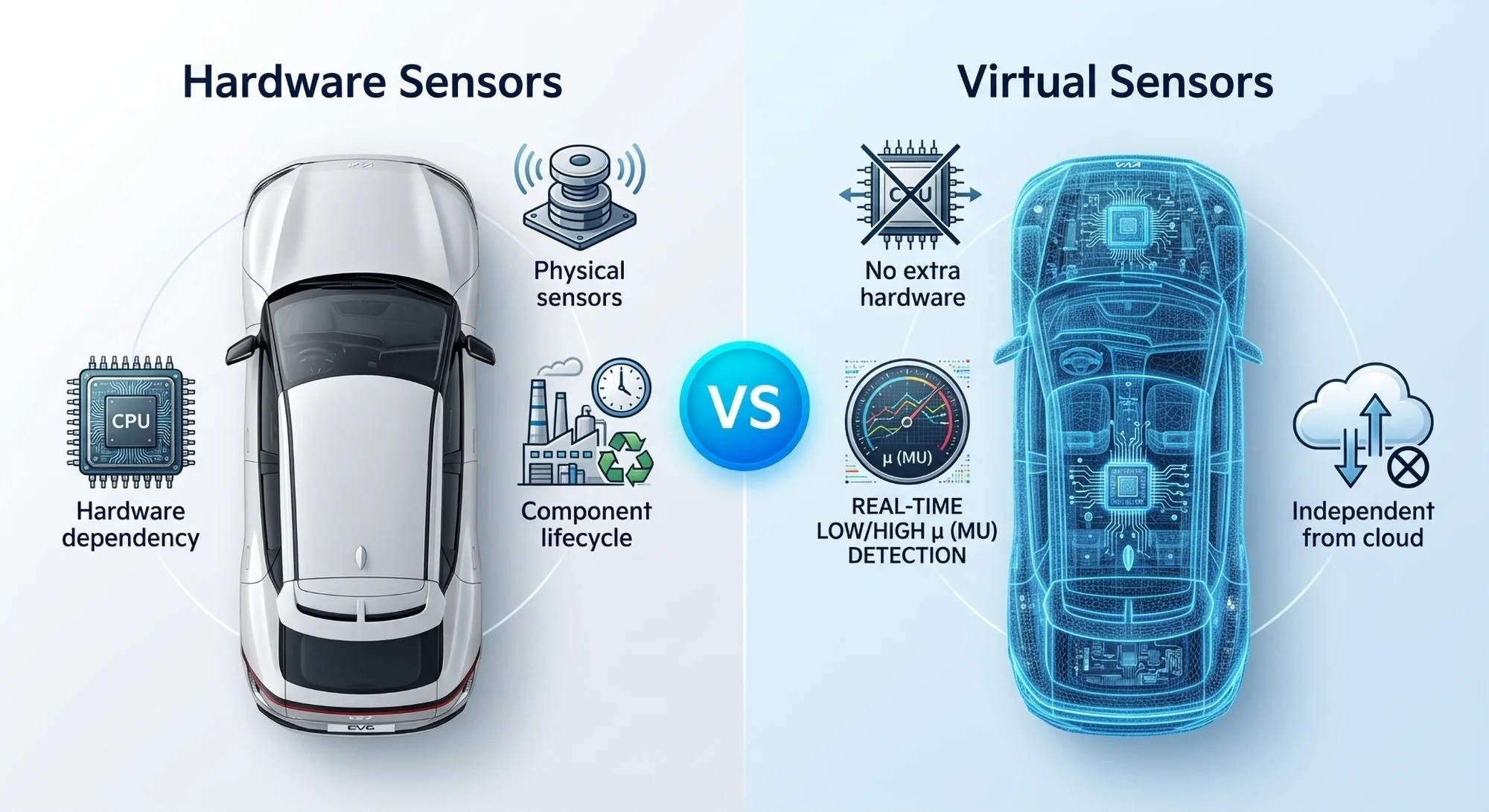
This is precisely where predictive sensing and active intervention technologies become compliance-critical tools for OEMs. Software platforms like DAI – Virtual Sensor Platform provide real-time virtual sensing of aquaplaning, snow, and ice – without added hardware – delivering the haptic-equivalent data that visual sensors (cameras, radar, LiDAR) cannot. For validation engineers, DAI offers millisecond-level detection of partial and full aquaplaning, self-calibrating and tire-independent, directly feeding ADAS logic with the surface data the standard demands.
At the cloud layer, ERC – Cloud Infrastructure aggregates real-time grip conditions, road hazards, and vehicle health data across entire fleets and geographies – creating the kind of live, predictive road intelligence that both regulators and fleet operators will increasingly require to demonstrate systemic safety, not just vehicle-level compliance.
When conditions exceed what software alone can manage, AIS – Active Safety System acts at the physical layer: the world’s first active system that restores grip by intelligently spraying pressurized fluid ahead of the tires, eliminating the water layer before control is lost. Proven to reduce braking distance by 20% on heavy wet surfaces and increase lateral traction by 225% in aquaplaning conditions, AIS extends the operational envelope of autonomous systems into conditions where ABS and ESC cannot intervene.
For OEMs pursuing GB 44721-2026 certification, combining DAI’s predictive sensing, ERC’s road intelligence infrastructure, and AIS’s active grip restoration provides a coherent technical path to validating L3/L4 systems across the full range of adverse-condition scenarios the standard requires.
Key Data & Market Context
The regulatory push is backed by market momentum. According to CNEVPost and Gasgoo, L2 ADAS penetration in China’s new passenger vehicle sales reached approximately 70.5% in H1 2026 – up 10 percentage points year-on-year. Penetration of Navigation on Autopilot (NOA) functionality hit 34.2% in the same period, driven by falling hardware costs and the democratization of intelligent driving features in vehicles priced below 200,000 RMB.
The pipeline from mass-market L2 to commercially regulated L3 is no longer theoretical. It is a defined regulatory corridor, and GB 44721-2026 is its gate.
What to Expect Next
With the July 2027 enforcement date set, OEMs have a finite window to complete their safety dossiers, finalize ODD documentation, and validate their systems against the new benchmark. First movers – Changan and BAIC – have a head start, but the standard applies industry-wide.
The convergence of China’s mandatory framework and the newly adopted UN GTR No. 26 signals that autonomous vehicle safety is entering its enforcement era. For engineers and technology suppliers, the question is no longer whether rigorous standards will arrive – it is whether their systems are ready to meet them when they do.